Style charts · 5 min read
Types of necklines: a chart with technical flats
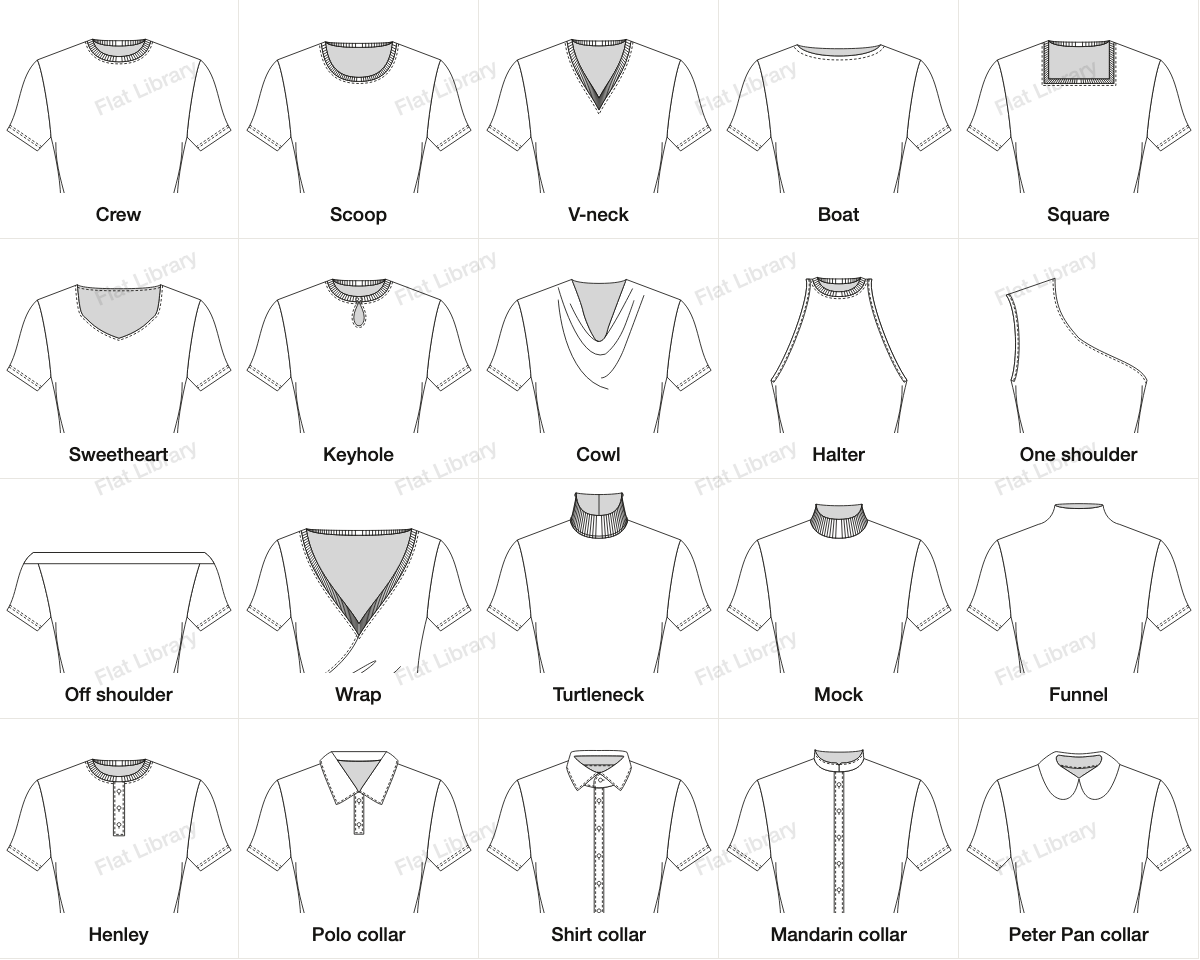
Twenty necklines and collars, drawn the same way on the same body, with what each one is called and what a factory needs to know to make it.
The short answer
Necklines fall into a few groups: low and open, like crew, scoop, V, boat and square; shaped, like sweetheart, keyhole and cowl; bare-shoulder, like halter, one shoulder and off shoulder; high, like turtleneck, mock and funnel; and collared or placket styles, like polo, shirt and mandarin. On a tech pack, always give the depth, the width and the edge finish.
Open round, V and square necklines
Crew neck. Close and round at the base of the neck, generally with a rib band. The everyday T-shirt neck.
Scoop neck. Lower and wider than a crew, in a soft curve. It often has a thin binding or a turned hem.
V-neck. Two straight lines that meet at a point. The depth is what changes the feel, and the point needs a clean mitre or a lapped finish.
Boat neck. Wide and shallow, running nearly straight from shoulder to shoulder along the collarbone.
Square neck. Three straight sides with corners. The corners take care to sew, so they should be precise on the flat.
Shaped necklines
Sweetheart. A heart shape, curving over the bust and dipping at the centre.
Keyhole. A small opening below a higher neckline, often closed above with a button and loop.
Cowl neck. Soft folds that hang from the shoulders. Usually cut on the bias, or in a fluid fabric. Draw it with a few long, tapered lines.
Wrap. One side crosses over the other, making a V. The overlap and how it is held should be clear from the flat.
Bare-shoulder styles
Halter. Straps or a band go around the back of the neck, leaving the shoulders bare. It often needs a different back view, so remember to draw one.
One shoulder. A diagonal line from one shoulder to under the other arm. As it is not symmetrical, you cannot simply mirror it when drawing.
Off shoulder. Sits below the shoulders across the upper arms, usually held by elastic or a fitted band.
High necklines
Turtleneck. A tall knit tube that folds over on itself. Mostly drawn with rib lines.
Mock neck. A shorter stand-up band that does not fold over.
Funnel neck. Rises straight from the body, with no separate collar piece.
Plackets and collars
Henley. A round neck with a short button placket. Show the correct number of buttons on your flat.
Polo collar. A soft, usually knit, collar with a short placket.
Shirt collar. A woven collar on a stand with a full button placket. There are many variations, like the spread, button-down and club.
Mandarin collar. A short stand-up collar with no fold, open slightly at the front.
Peter Pan collar. A flat collar with rounded ends that lies on the shoulders.
What to specify in a tech pack
A neckline name is not enough on its own. Your tech pack should cover:
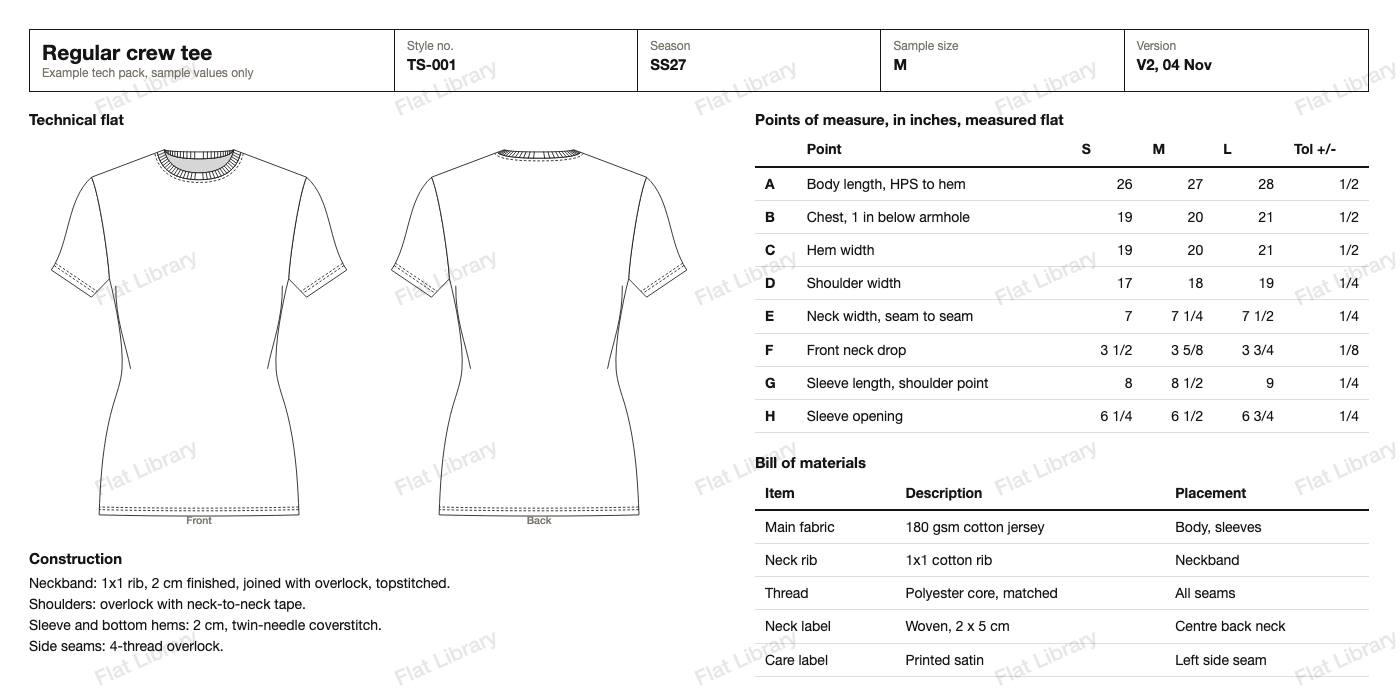
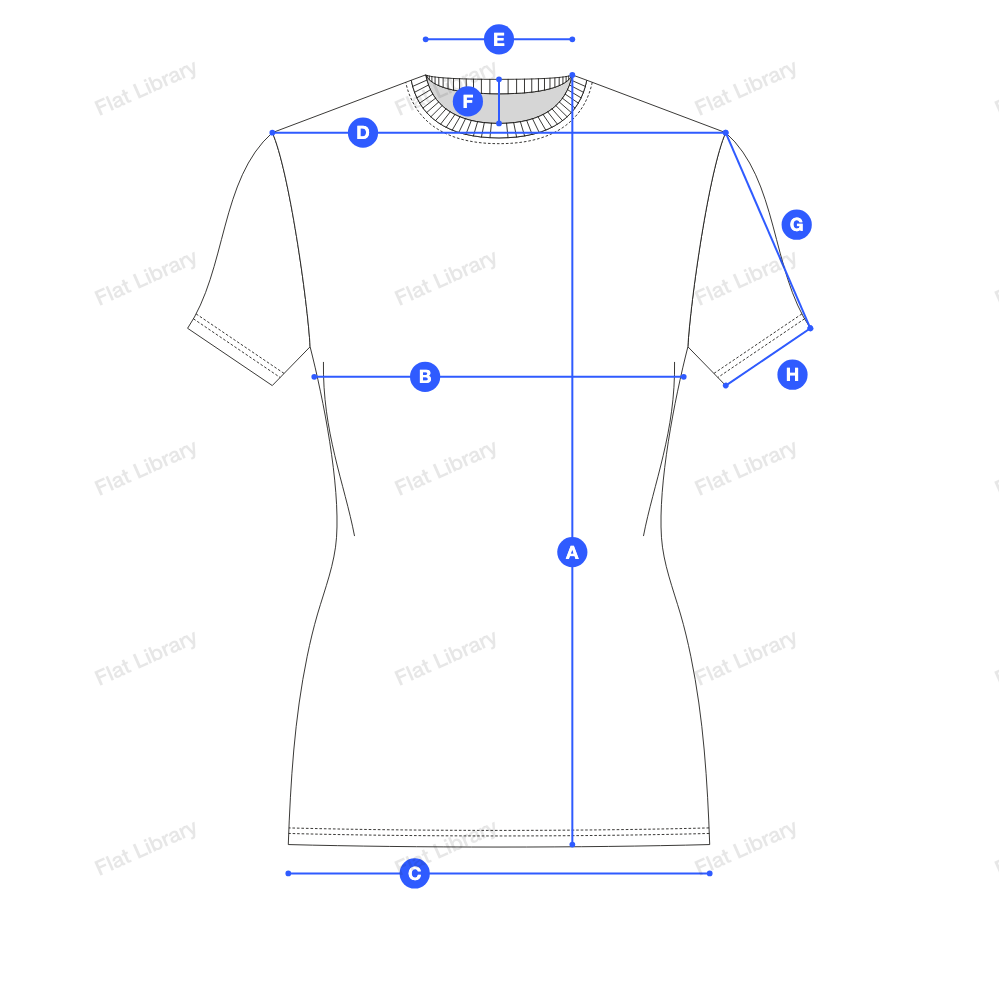
- Neck width, taken seam to seam at the shoulder.
- Front and back drop, so the factory knows how deep each one is.
- Edge finish, such as a rib, binding, facing or turned hem, with its finished width.
- Stitching, such as a topstitch below the band, and any tape across the back neck.
- How it opens. Does it go over the head? A narrow neck on a woven fabric needs a zip, a button or a slit.
Drawing necklines on a flat
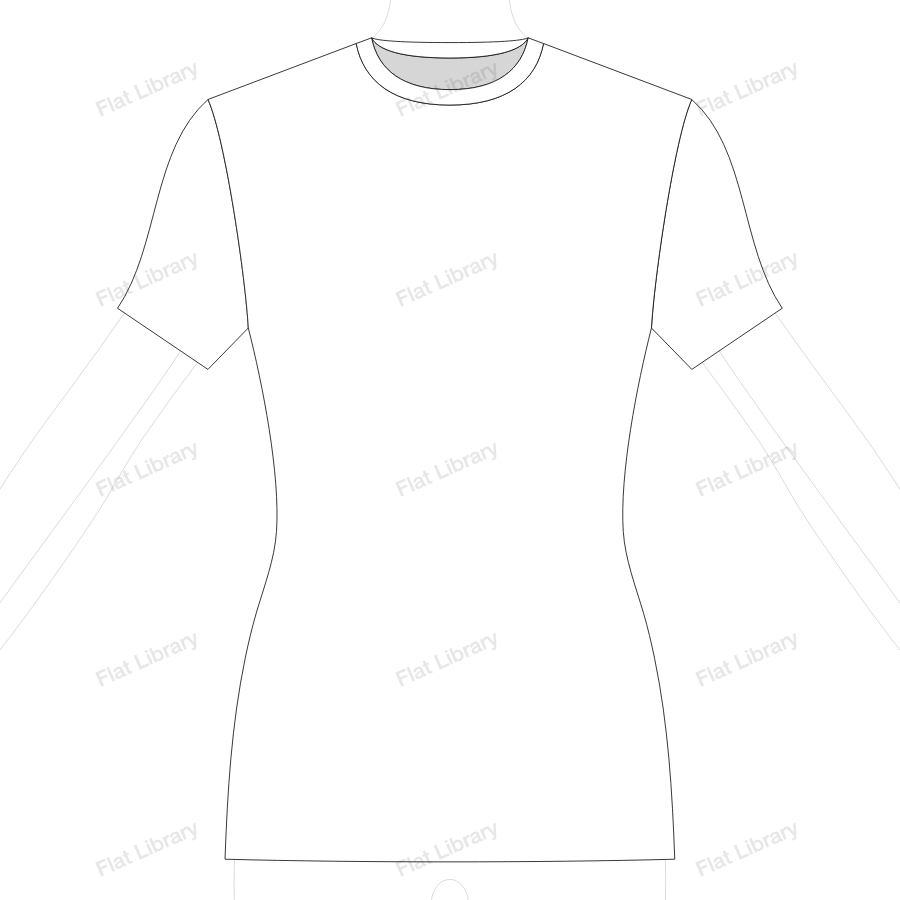
- Show the back neck and inside. On a low neck, the inner back of the garment shows through. Shade that part grey, so it reads as inside.
- Keep it symmetrical by drawing half and mirroring it, unless it is a wrap or a one shoulder.
- Draw the back neck too. It is usually much higher than the front, and a low back deserves its own view.
- Mind the corners. V and square points are where the sewing is hardest, and your drawing should make the finish plain.
The chart of sleeve types covers the other half of the top. Together, they give you a lot of tops to try.
Questions people ask
What is the most common neckline?
The crew neck, a close round neckline usually finished with a rib, is the standard on T-shirts and sweatshirts. V-necks and scoop necks are the next most familiar on everyday tops.
What is the difference between a crew neck and a scoop neck?
A crew neck sits high and close to the base of the neck, usually with a rib. A scoop neck is cut lower and wider in a rounded curve, showing more of the chest and collarbone.
What is the difference between a turtleneck, a mock neck and a funnel neck?
A turtleneck is a tall tube that folds over on itself. A mock neck is shorter and stands up without folding. A funnel neck rises as an extension of the body with no separate collar, and it usually stands a little away from the neck.
What is the difference between a neckline and a collar?
A neckline is the shape of the opening. A collar is a separate piece attached around it. A shirt has both: a neckline that the collar is sewn to.
How do you measure a neckline for a tech pack?
Usually with neck width, from seam to seam at the top of the shoulder, and front and back neck drop, measured from the high point of the shoulder or a line between the two neck points. State your method on the page, since these can be taken in several ways.
What is a keyhole neckline?
A round or high neckline with a small teardrop or circular opening cut out below it at the centre front or back. It usually fastens above the opening with a button and loop, or a tie.